
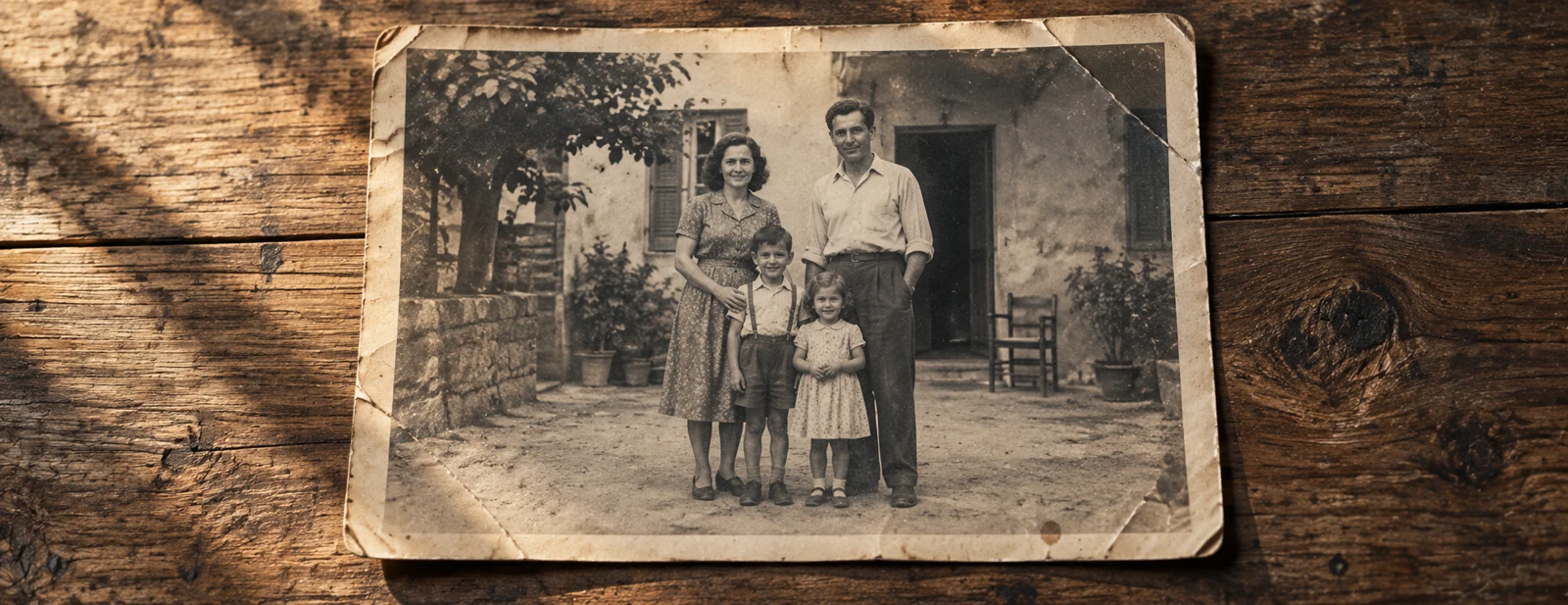
There is a childhood photograph of me that still exists because somebody kept it.
It came from a time when taking a photograph required slightly more commitment.
There was a roll of film. There were a limited number of frames. At a wedding or family function, one or two photographers had to decide which moments were worth using those frames on.
They did not always get it right.
Someone blinked. The image was not perfectly focused. A person was cut off. The lighting was strange. Sometimes the moment everyone wanted was missed completely.
But the photograph that came out was the photograph the family had.
It went into an album, an envelope, a drawer or a cupboard. Somebody usually knew where it was, at least vaguely.
Every time the photograph was handled, something happened to the object. A fingerprint stayed. A corner bent. The colour faded. A scratch appeared. The paper collected evidence that people had touched it and time had passed around it.
The moment inside the photograph did not change.
The object did.
That is what makes a physical photograph slightly strange. It freezes a fraction of a second, but the paper still has to survive every year that comes after it.
Digital photography solved many real problems.
We can take more photographs. We can keep backups. We can send an image to somebody across the world in seconds. If one phone breaks, the photograph may still exist somewhere else.
That is not a small achievement, and this is not an argument for pretending digital photography is bad.
But something subtle changed when photographs became abundant.
We can take fifty photographs before leaving the house. We can keep the close-up, the wide shot, the serious face and the one where somebody sticks out their tongue. We do not have to choose.
The images move from a gallery to a cloud, from the cloud to social media and from social media to somebody else's phone. They can be copied repeatedly without the copy experiencing any wear.
We did not stop preserving moments.
We stopped having to choose just one.
When every version can stay, no single frame has to become the one photograph everybody remembers.
A digital copy can show the scratch on my childhood photograph. It can reproduce the faded colour and the damaged edge with extraordinary accuracy.
But only the physical photograph was scratched.
The file preserves what the object looks like. The object carries evidence of what happened to it.
This does not mean every photograph needs to become rare, expensive or difficult to access. It does not mean we should deliberately destroy copies to manufacture importance.
It only means that physicality gives certain things another kind of meaning.
An object can be lost. It can be damaged. It can disappear completely. Because of that, somebody has to decide that it is worth keeping.
Children growing up now may have more photographs of themselves than any generation before them. I wonder how many will have one worn photograph whose location they know because it has been kept in the same place for years.
Maybe the answer is not to take fewer photographs.
Maybe it is simply to choose one sometimes.
Print it. Put it somewhere. Allow it to collect evidence that it was part of a life and not only a file moving between screens.
A photograph does not stop time.
It survives it.
Print one photograph worth keeping.
STILL LOOKING, SAM.